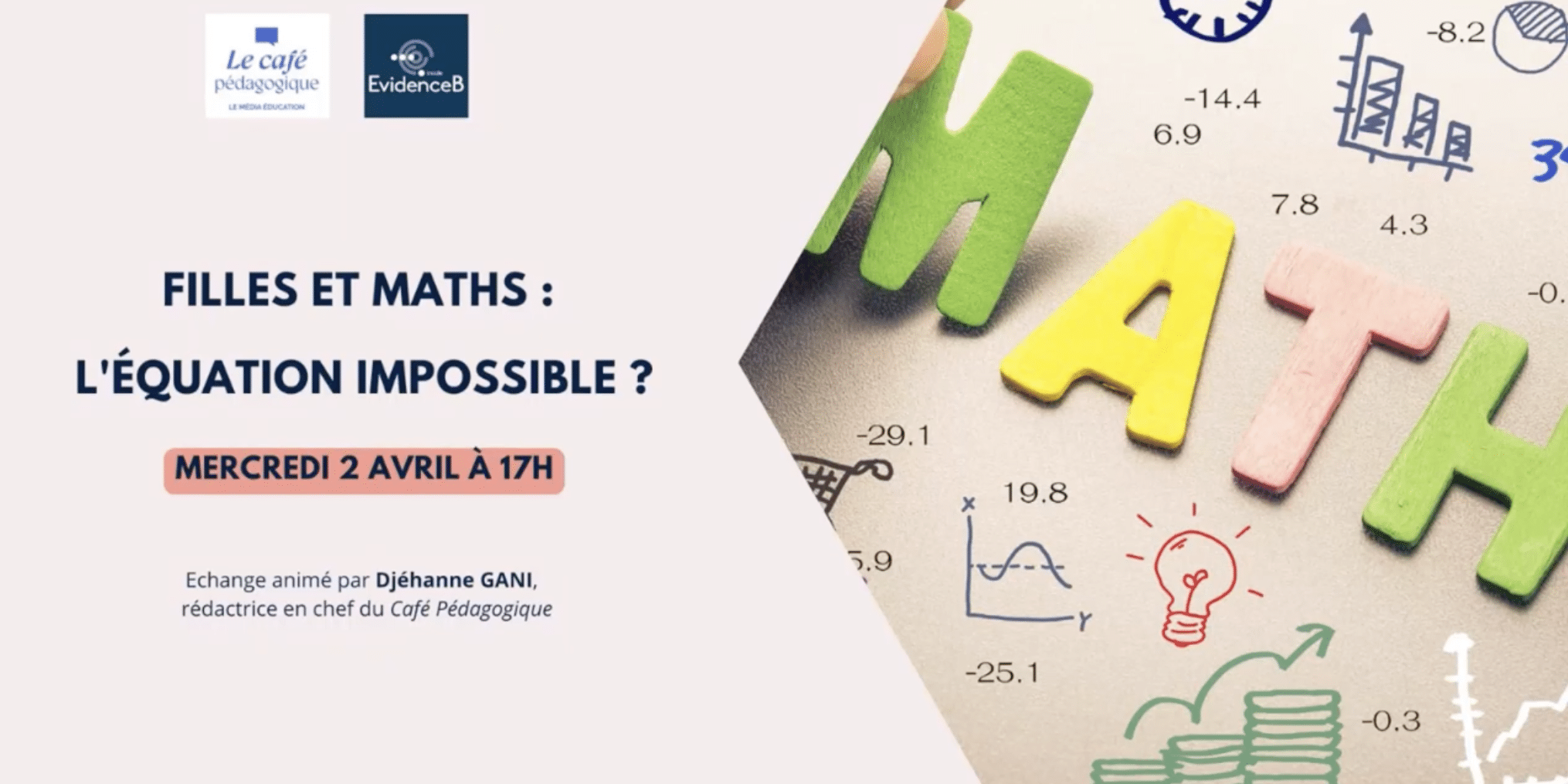

The roundtable discussion entitled « Girls and Math: An Impossible Equation? » addressed the persistent inequalities between girls and boys in scientific fields, particularly mathematics. Studies show that a gap favoring boys emerges as early as first grade and continues to widen throughout their schooling. This gap contributes to gendered career choices and the persistent underrepresentation of women in science, technology, and engineering (STEM) fields.
The findings: a gradual decline in girls’ performance
According to Christophe Hérault, a mathematics teacher at the Pierre-Gilles de Gennes high school, many female students drop out of the mathematics specialization, often not due to a lack of ability, but rather a lack of self-confidence. He notes a frequent form of self-censorship: the girls fear they won’t « be up to the task » despite achieving good grades. This disengagement is therefore not strictly linked to performance, but to their perception of their abilities.
Leïla Bessila, a doctoral student in astrophysics at the École des Mines de Paris, reinforces this observation by highlighting powerful socio-cultural barriers. She particularly emphasizes imposter syndrome, which is very common among young women in scientific fields. Through educational workshops conducted with students, she works on the image of science and the deconstruction of gender stereotypes.
Multiple causes
Una McCarthy-Fakhry, a gender andeducation expert at UNESCO, points out that women represent only 35% of STEM graduates. She observes that girls have a greater fear of mathematics, partly linked to cultural and social factors. She believes that families, the media, and educational institutions have a crucial role to play in reversing this trend. She calls for collective awareness and suggests drawing on the numerous resources produced by UNESCO on this subject.
Franck Ramus, a cognitive scientist at the CNRS and a member of the National Education Scientific Council, emphasizes the complexity of the issue. He points out that the observed gaps between girls and boys in mathematics result from an interaction of multiple factors: social, cognitive, biological, and linguistic. He notes, for example, that certain brain differences exist, but that they alone cannot explain the performance gaps. It also raises the question of gendered family structures, which could impact girls’ academic performance.
Concrete teaching strategies
To change the situation, several educational approaches are proposed:
-
-
- Reorganize classroom dynamics to give girls more of a voice and encourage them to participate actively.
-
- Working on the image of science with students from middle school and high school onwards, by addressing stereotypes directly.
- To train teachers on gender issues, to enable them to identify and correct unconscious biases.
-
According to the 2023 results of the international TIMSS study, France is one of the countries with the most difficulties in mathematics at the CM1 level (fourth grade), and exhibits the largest performance gap between girls and boys of all OECD countries. These inequalities are therefore not only academic: they also reflect a gendered social environment that hinders girls’ scientific ambitions from a very young age.
The roundtable highlighted that inequalities between girls and boys in mathematics do not stem from a difference in ability, but from a social, cultural, and educational construct. Far from being an « impossible equation, » the goal of equality in scientific fields requires collective action: teachers, families, the media, and policymakers must work together to change perceptions and support the ambitions of young women.
Djéhanne Gani
Some reading material :
37366) | The EDP Sciences shop: e-bookstore, online sales of scientific books and ebooks
UNESCO resources
STEM education for girls and women: breaking barriers and exploring gender inequality in Asia – UNESCO Digit al Library
boosting_gender_equality_in_science_and_technology.pdf
Women’s participation in higher education in Southern Africa: an exploration of STEM, leadership and en rollment in institutions in Botswana, Eswatini, Lesotho, Malawi, Mozambique, Namibia, South Africa, Zambia, and Zimbabwe – UNESCO Digital Library
Changing the e quation: securing STEM futures for women – UNESCO Digital Library
Support girls and women to pursue STEM subjects and careers: advocacy brief – UNESCO Digital Library
April 2021: Female science and mathematics teachers: Better than they think? | IEA.nl
June 2023: Early learning activities matter for girls’ and boys’ mathematics and science achievement | IEA.nl
Link to the video: Innovative Fields Conference, Roundtable: Girls and Maths – The Impossible Equation, April 2, 2025